
Alexander Sergeyevich Pushkin (1799-1837)
Posted by PuJa on Maret 27, 2010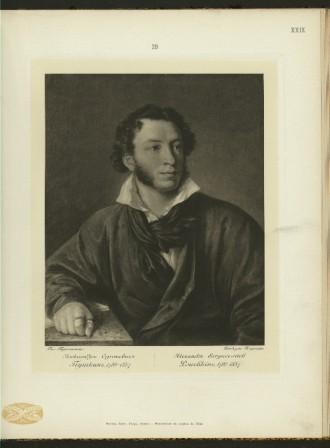
Written by Nurel Javissyarqi
Translated by Agus B. Harianto
KEPADA PENYAIR
Alexander Pushkin
Pantangkan penyair, mengharap sanjung yang ramai.
Riuh tepuk mereka sebentar mati gemanya;
Lalu kaudengar putusan timbangan Pak Tolol
Dan ketawa halayak yang bikin hati patah;
Tapi andai kau teguh, tak guncang dan sederhana,
Rajalah engkau dan nasib raja hidup sendiri.
Bathin bebas didiri berseru padamu: Teruskan!
Sempurnakan kuntum indah dari mimpi-mimpimu,
Tapi jangan harap-puji atas buah ciptamu.
Puji berakar di bathin; hakimnya engkau sendiri,
Dan ambil putusan terkeras terhadap diri sendiri.
Tapi, andai kau puas, biar itu kawanan menggonggong
Peduli mereka meludah dinyala siar mimbarmu
Dan pada tarian asap menyan dari kuilmu.
TO THE POET
By Alexander Pushkin
Prohibit the poet, to expect an avowedly flattered.
The noisy of their applause just a moment and then its echoes would turn off;
Then you hear the decision of the Mr. Stupid consideration
And laughter of the audiences would make broken heart;
But if you tough, be stable and simple,
Then you are the king and the fate of the king is live alone.
The heart is free in self calling to you: Move on!
Refine beautiful sheaths of your dreams,
But do not expect praise for the fruit of your creations.
The praise is rooted in the inner; the judge is yourself,
And take the hardest decision for yourself.
But, if you’re satisfied, ignores the mob barking
Hell with them spit on the platform of your speaks
And at the dancing of incense smoke of your temple.
*) Took from the book “Puisi Dunia” (World Poetry), vol. I, compiled by M. Taslim Ali, Balai Pustaka, 1952, which is retranslated into English would be more or less like above.
In the enlightenment ages at 19th-century, Russian literary precede grandeur Classical flow, pioneered by Krylov, Derzjawin, Joukowsky, and the top was Alexander Sergeyevich Pushkin (1799-1837). Such as any other East Europe poets, if we know Byron, we would be touched by concertos, but Byron romanticism to Pushkin had changed to be realistic style. In the age of 22 years, he published his essay “Ruslan and Ludmilla” and followed by “Prisoner in the Caucasus” which he composed in his exile. His plays of history entitle “Boris Godunov” and his other poems are “Poltawa” (1828) also sensed romanticism, but since he met Shakespeare, it took him inclined to the realistic. The most tragic reality, his manhood was putting on bet in a fencing bout, until it finished his life in 1837.
***
As hard song in the head, the stones of establishment hit a solid time of beliefs, the poet warrior, that’s what I called on his name.
He didn’t stop to stab the dagger of seriousness, by the word until to be shivering; his mental was forged by himself in the sphere of times.
His firmness was as tough as the ancient tree and his soul had not impervious to be sawed off by the mournful and mass fury.
He squeezed like a ship in the middle of the ocean which is impossible to plant the anchor, dancing to follow the rhythm of the inners waves.
A fireball was sliding down spitted by the dragon, he was endlessly to have strong willing, and for him it was futile of punishment of silence and too long applause.
Because the truth is the courage, his heart was rejuvenating, but his soul was as old as lush of the sky leaves, by the knowledge of comprehended the library of the world.
He didn’t want to be dead in vain, brought his fate far that was far to the top of mountain of poems.
No wind all would be empty when his literary breathed on the sentences, the beauty of memory by carrying the sun.
No reward, only the strong human being is willing to understand the colors, from where Pushkin painted history.
The everyday motivation was boiling up to inspire anything, toward the end of the trial to determinate the words.
The passed path wouldn’t walk through, if collided wouldn’t licked at the decay.
The blown out desire of his heart had pumped by millions of times, reached by the longing beyond the eyes.
The story of the poets was completed, he occupied the corner he believed, and the distance calculated to mature the deed.
The nerves were anxious surpassed poetic reasoning critics; his analysis like the speed charred star swallowed by the changes.
It was not a roll of the dice, but his brain observed the sleep and brought the dreams of the most beauty composition until to be awakened up.
He wrote at the late of night of the emptiness of body has an abundance; self torture is the hard of endeavor to drag in passing aura.
He boiled it up in the stove of spirit, mixed up and to be solid as much as pieces of debris incarnate to be union.
His magnet of intention bonded with embedded flesh of reddish seriousness, the ripen fruit was served by the sun hospitality.
The life was put on bet by the bravery, madness behind romantic of reality to the tragic threshold of insanity.
From there, rooted the consciousness of words that begun from echo, the scratch of meaning bloom to be millions in the skulls.
The language of colors circumference flied transcontinental, planets and even galaxies of night was not the night if without wine of numb.
Another side of heart of the artists at stake, the feeling was vanished beaten by the reality that took by confusing choice.
But don’t the height of view lay down a body of firmament, the voice of words infiltrates from the limits of substances of his era.
Until the motivation of life and death awaken and wandering, a tick of surpassed trigger capable to return the memories.
He didn’t feel the repeated fall, he had already understood onto the ocean of the future, much more roaring the interpreted at that time.
Without inattentive to spill the absorbed, the sucks of opium had apprehended by the seriousness surpassed the shaman of coconut milk squeezing.
It is endlessly rotation needles to seek for unmatched and no comparison; the feeling since from the feeling had been numb, but Pushkin was there.
It was so heavy to carry the burden of words on the hard city, the struggle of life and death in the curse of punishment of solitariness, if the legs are still riding the horse to believe.
What he carried in his life, the hardest beating would not make happy or violent out of control.
He remained convinced; the aware of words to the death covered by the sick but still resigned.
In the last of this writing I dedicated a poem for you:
FOR ALEXANDER PUSJKIN
Lamented the cliff of the fate
his heart nestled grove,
he brought the curse of the prophets
the sorrow life makes cavity of eternal.
When the wind in his fingers
creep the intricacies of time,
the body that had buried by the night
flapped by the wing of the sea.
http://www.sastra-indonesia.com/2010/01/alexander-sergeyevich-pushkin-1799-1837/
Leave a Reply
You must be logged in to post a comment. [Disabled, because any spamms]