
Kitab Para Malaikat (Book of the Angels)
Posted by PuJa on Oktober 27, 2009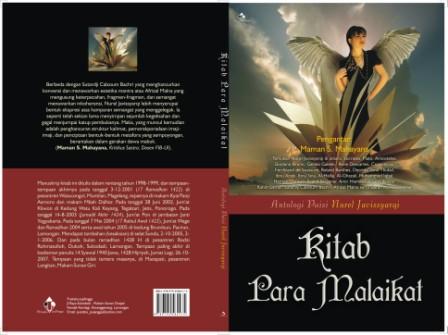
Prologue: By Maman S. Mahayana
Found Nurel Javissyarqi in among: Socrates, Plato, Aristoteles, Giodano Bruno, Galileo Galelei, Rene Descartes, Copernicus, Ferdinand De Sausures, Roland Barthes, Derrida, Ibnu Thufail, Ibnu Arabi, Ibnu Sina, Al-Hallaj, Al- Ghazali, Muhammad Iqbal, Hamzah Fansuri, Syekh Siti Jenar, Amir Hamzah, Chairil Anwar, Kahlil Gibran, Sutarji Calzoum Bachri, Afrizal Malna also the theory of Confucianism.
Poetry Anthology By Nurel Javissyarqi
Kitab Para Malaikat (Book of the Angels)
Motto: “Buku bukan sekedar menyapa, tapi juga sarana berdialog dengan dunia”.
The book does not only accost you, but also the medium of doing conversation with the world.
Prologue : Maman S. Mahayana
Epilogue : Herry Lamongan
Translator : Agus B. Harianto
Cover : MN. Jihad
Layout : AGO
First publication, December 2007
Published by Pustaka puJangga
Jl. Raya Sukodadi- Makam Sunan Drajad.
Kendal- Kemlagi, Karanggeneg, Lamongan.
pustaka_pujangga@yahoo.com
http://pustakapujangga.com/
X + 130 page; 15,5 x 23,5 cm
ISBN: 978-979-58-247-5
Table of Contents:
iii- Prologue: Fascinated Dark Alley by Maman S. Mahayana
ix- Table of Content
1- Preface; Time in the Angel’s Wings
5- Open the Body of Padmi
11- Laws of Lover
19. Devoting Couplets
25- Spaces Perpetuate
31- Music- Dancing of eternality
35- Foamed by Odorous Night
39- Desire of Glory
45- Above the Sky Stretcher
51- Tributary of philosophy
57- A flower of revolution
63- Appearance of Last Night’s Prayer
69- Profound Sorrow of Foam
75- Wave Nurses Beach
81- Returns the Holy Intention
87- Developer of Mysterious World
93- Noon is Body, Night is Soul
99- A Censure of Gift’s Light
105- Birth Land of Time
111- Solid of Time- Space
117- The end; testimonies
125- Epilogue: A Letter for Male Guerrilla Fighter by Herry Lamongan
126- Explanation for the Book of Angels
129- About Writer
PROLOG: FASCINATING DARK ALLEY
Writer by Maman S. Mahayana
Translated by Agus B. Harianto
The stretching of seethed passion, when it can’t hold any more and then it crack, very instant at that time, its expression is poured out to come out scatter around, splashed, beat anything. And then perch on any place that it touched by in any way its like. Perhaps it doesn’t mean any at all to do accosting and addressing, say hello, or even pursuing. It just wants to describe the mount of nervous that very long time lies down in the heart and brood in the kingdom of its ideas. It could be born by its awareness, that the ideas which very long times imprisoned, will have bad result to the explaining brains and the heartbeat. Perhaps there is also another consciousness that God do not prohibit his creature to tell story about anything, doesn’t it have no rule which states that God will punish the human whom let loose his imagination to wander in to any zone of other’s imagination? Even, on the contrary, God place the human as the creature that have higher grade than the others, just precisely, because the factor of that imagination.
In that context, Nurel Javissyarqi in his poetry’s anthology, the Kitab Para Malaikat is alike represent his awareness about the zone of imagination, just pay close attention to the whole of line that he created in this his poetry’s anthology. He was so energetic to scatter about the seething of his passion. He looks like deliberately enjoy his freedom to express. There fore, what we will get from the lines of his poetry are the freedom to recover a combination of problem (: theme) as his logical reason like and as his logical reason want to say those. He looks like doesn’t care about the convention. What he was doing is free the imagination from the jail that shackle assumed by him. There fore, scatter around the style of reduplication that felt fresher. Besides that, the clamor is appear on a numerical of ideas which jumping, perch anywhere, and wandering in to other’s hemisphere that can’t imagine. Those are, the act of free imaginatively; freedom to think, freedom to express, which is already have its own history that is very long and tiring.
***
Do you still remember Socrates that chose to drink the poison than be tray on his believe to express? Plato, Aristoteles and long list of the past thinker’s names are the man had embellished the long history of freedom to think, to express, to imagine. Came from there of the cultural and human civilization rolling rapidly without holder. Remember either, on Giordano Bruno that burnt lively because his struggling carried out the freedom to think. Galileo Galilee, Rene Descartes, Copernicus, and a lot of other names in the lists of West thinker are the figures that moved in the fighting of thinking. And then, came from there the knowledge grow adoringly until the human have the ability to spell his self-identity perfectly. Until now those names are keep haunting, even tough a lot of other figure, like Ferdinand de Saussure, Roland Barthes, Derrida, until the proponents of postmodernism- post structuralism- had firmly existed to replace them.
At East, the lists of names are not being of lesser on its long. Ibn thufail, Ibn Arabi, Ibn Sina, Al- hallaj, Al Ghazali, Muhammad Iqbal and then into our world- Hamzah Fansuri and Syekh Siti Jenar- were the figure that directly or not, were included to changed and give the base of their thinking in the culture- civilization and Indonesian’s literature. So the wildness and the wiling to carry out the freedom to create are really not a new thing. The problem now is just left; will it destroy the old paradigms? – According to the Thomas khun’s ideas- and implant the new paradigms or just want to rebellion.
In the literature’s world, empirical cycles or the rotation of those paradigms are blown into the concept of tension between convention and innovation. Pull each other between convention and innovation are really base on the wish to express the freedom to create, to do creatively explorations, and exploit several possibility of aesthetic. In these things, licencia poetica (= poetry license) be based on the enthusiasm to offer the new things, new creativity, and force the old convention into corner to become something stared as out of date, worn out, superannuated. Therefore, what the next emerge is the renewal that in the literary work (text) into a numerical substance of its intrinsic, even not close tightly on the aspect of its extrinsically. That is the world of literature, the world that in there have too many kind of creatively happening are attended with the consciousness of aesthetic which really tight of its connection with culture’s nervousness.
In the journey’s map of Indonesian’s poetizing, the list name of avant-garde, like Amir Hamzah, Chairil Anwar, Sutarji Calzoum Bachri, Afrizal Malna and any others name that scatter around in the map of Indonesian’s pertaining to poetry, that in the essence, they were also struggle in the pulling each other between convention and innovation.
Even though like that, we are not close our eyes either on appear in numbers of our contemporary’s poet that also doing a desertion, rebellion on the name of innovation, on the name of creativity, on the name of renewal. Some times, he carry out the enthusiasm just want to be different experimental. Fine, in fact, God does not prohibit the human kind to do it. So, it is legal if on the next time appear Indonesian’s poet that also want to do the movement of freedom to be creatively. Maybe, he didn’t satisfy on the style of the old aesthetic. Maybe also he has consciousness of aesthetic to do pursuing. It could be rather carry out the enthusiasm just want to be different, alike the other possibility that he couldn’t hold the seething of his mount ideas.
With those consciousness and those understanding, so, now we face the poetry’s anthology by Nurel Javissyarqi that impressed on its many kinds ideas spurt, scatter out of wild ideas, and the complicated is, we found the conventional pattern of ruling to use the usual language, every things are allowed and legal. He does not break the law of God. He just wants to rebel into the convention of poetic, into the expression of using the language that is in its history, usually always assaulted by rebellion. Then, how do its efforts? How does Nurel move his creativity?
***
As poetry that fully with ideas and wild of its imagination, we are really alike facing against with long alley that is in there scattered about the other alleys too, which have so many branches off. Different with Sutarji Calzoum Bachri who destroys the convention and offers the aesthetic of spell or Afrizal Malna who carry out the dissension, fragments, and the enthusiasm to offers incoherence, Nurel Javisyyarqi does more look similar like the pattern of express on the stretching of seethed enthusiasm. He seen like saved a lot of nervousness in very long time and failed to meet the valve of its opener. Therefore, what appears in the next is the destruction on the sentence, in disordering of imagination, and the creating on the pattern of staggered metaphor, mess in the moving of drunken Master. The attractive deed by Nurel is also the creating of the pattern of reduplication that felt fresh, even though those are not the new things. Mentioned, the words; mewangi (being odor or fragrant), pepintu (doors), wewaktu (times), pepohon (trees), bebayang (shadows), gegunung (mountains) and etc. to show the plural form of those words.
The searching on contents sometimes facing the failure. But, that is precisely the challenging. There is a kind of terror, but, not in the level of create the disturbance in our mind. In fact, in several things, we still can get the style of Khalil Gibran or Muhammad Iqbal. Check this out, these few lines when Nurel talk about the world of women:
Perempuan itu kembang di petamanan mimpi
….(I: X)
Kaulah perempuan, dari kerajaan misteri (I: XIX)
(The women are the flower in the park of dreams
You are the woman, from the kingdom of mystery)
Aren’t those styles reminding us on the reflection style of Khalil Gibran? In a lot of things, some times those impression touch the feeling of our aesthetic context. And out of it, we suddenly attacked by the others wild ideas, out of control, until it inclined become terror. Pay attention on these lines that narrate the beauty face of the women:
Alis kerudung kedua bagimu, bila alis dicukur habis
Hilanglah bulan sabit menggantung anggun di tengah malam,
Sedang lampu-lampu kota adalah hiasan. (I: XXXVII)
(The eyebrows are the second veils for you, if it shaved until there is nothing left
Lost the crescent hand nicely on the middle of night,
While the town’s lamps are just accessories.)
Two lines at the first show, how very the eyebrows of women are important accessories that become part of beauties, even more as the sensuality of the women. But, how its relation with the town’s lamps that he putted as the decoration? In here is, the clip of women’s sensuality- curved eyebrows that alike the crescent are- suddenly attacked by the town’s lamps, how is its relation, its association, and the clip of its imagination? Those are one of the terror that seems like obviously created to destroy the imagination it self.
In the other case, Nurel acted like the figure of hermit that is in the certain things, sometimes dazzled his self become the figure of Sisifus. He just wants to wish, to do, and moved with brings his wild imagination in to the alleys.
Check again onto these lines:
Mari hadir bersama keindahan, bimbing kesadaran alam hingga terdalam
Sia-sia dipenuhi hikmah, malapetaka bila ajaran berharga dibuat bangga (I: LX)
(Lets attend together with the beauty, lead the awareness of nature until into the deepest
Useless be fulfilled by wisdom, disaster if the valued theory made proud.
I imagine the figure of Iqbal or Gibran told his command words about the beauties, about the nature that spatters the beauties of God. So, why either the human get the wisdom, assumed useless. Then what is the meaning on the disaster if valued theory made proud? It could be, doctrine, theory, or wisdom, enough as light’s giver into the heart, and doesn’t need to make somebody become haughty, forget about his self. Does the light of God or the spattering of those God’s light as the representation from wisdom, from the theory that gives brighten?
The style of advising on the religious matters, in everywhere seem like obviously attended as manifesting the figure of I as if the “I” is the writer his self that put him as “Resi” (title of ascetic) or the hermit that speech from the peak of mountain. Several of his instructions are fascinate, even though sometimes bring us into the dark alley or the ideas that roaming in the middle of jungle hood.
Kunang- kunang terbang malam, berikan cahanya pada kalian/ the glowworm fly at night, gives its light to us/ an instruction which remind me on the theory of Confucianism. But what happen next in the line of: kumpulan tersebut, terselimuti kegelapan yang terjaga// (IV: XCVIII) those group, blanketed by awaked darkness// in those context, seem, there is enthusiasm to build the paradox. Then, what the content of the instruction if the willing give brighten, enter the blanket of darkness?
***
In a whole scale, Nurel Javissyarqi in his poetry anthology, kitab para malaikat, the book of the angels is carry out a lot things, offer many kinds of philosophy’s thinking and absorb the influence from so many philosophers. But, remember how fully is the idea that hangs on his brain, he seen like want to do releasing sonly. He will spray the whole things in a taking of breathing. That is his problem. A desire that culminating, drooping for long times suddenly break the damn of its blocker, thus the desire is spurt break anything, pulverize- crush to everything that on the front of it. With that way, the impressions that suddenly appear are a combination of infatuated, somnolent, ecstasy that drunk to its self. Therefore, the ideas throw out are the voice of his own thinking which like the bullet of machine gun that precisely can harm a lot of message that he willing to offer.
The anthology of Kitab Para Malaikat had arranged into twenty chapters. The last chapter seem send the news of a combination of testimony by several experience that treated by him as sifter of inner heart and thinking on figure of Nurel Javissyarqi. He was enjoying his life that was out of grade as the hunting on the ideas. Those why, can be understood that if Nurel seem like have no power to hold the burden of his own mount ideas.
Out of those problems, I enjoy on this poetry anthology as the figure of wanderer that lost in the vast forest hood. There is passion to sonly get out from the deviation, but, in fact, it is fascinate too, when enjoy his deviation. Like the figure Sisifus. Just enjoy it; therefore, we will arrive into the right way, at later, some day!
Bojonggede, April 30, 2006
By Maman S. Mahayana
Paseban, Bojonggede, Depok.
Leave a Reply
You must be logged in to post a comment. [Disabled, because any spamms]